 |
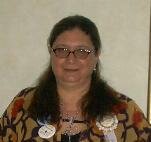
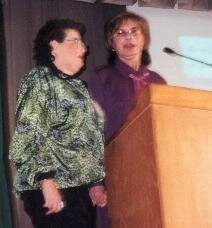
Myrna Soll with Aimee Hall
We had the chance to talk to support group leader, Amiee Hall of East Philadelphia, Pa. Aimee’s support group quickly grew and became several groups with over 200 members. Her organizational skills are amazing, as you will see here. She is a firm believer in laughter, joy and advocacy.
OFCW: Could you tell us a little about yourself and how you find out you ad Fibromyalgia?
Amiee: I was in a work related accident in August of 1987 and after about six months the pain was not lessening. I had headaches, chest, shoulder and neck pain, as well as pain in the rib cage. I could not keep up with my job as a final welder and eventually had to leave. Over the next 10 years I had 7 other jobs, none of which paid as well! They included jobs as childcare worker for abused children, toll collector on the turnpike, and as a health care worker for the elderly. While I was still working, I kept getting sicker and going to different doctors. During this time I was diagnosed with a vascular necrosis of the wrist. I was admitted to John Hopkins for a bone graft, bone fusion and a vessel graft. Despite these problems, I saw a variety of doctors—between 7 and 10—that insisted that I had psychological problems. One even tried to have me admitted to a psychiatric hospital.
Eventually, I was seeing a physical therapist, sitting in the office waiting for my appointment; I saw a brochure on Fibromyalgia and read the list of symptoms. I thought “Oh! That’s me! That’s what is wrong!” I took it to my general practitioner and showed it to him. He referred me to a rheumatologist and she confirmed the diagnosis.
OFCW: How did you learn so much regarding the disorder quickly?
Amiee: I learned a lot from the Internet. I met some great people that way and credit them with saving my life. Unfortunately, I had hit bottom. I fell into a period of depression and apathy. I was unable to respond to the crucial events of my children’s lives such as marriage and the birth of their children. (Editor’s Note: Amiee has raised 7 children; 2 birth children and 5 stepchildren!) A friend told me about the FMS chat room at Sapient Health (later WebMD). The amount of information there was incredible; and the people I met realized I was depressed and drew me out of myself.
OFCW: It seems that it took you a long time to get a diagnosis and you went through some of the characteristic and painful misinterpretation of symptoms so many experience. Despite being told you had a problem, you bounced back. When did you form your support group?
Amiee: I was involved in the group pretty quickly. It is about 5 years old now and actually 4 groups. The physical therapist was a great help and got me started. She noticed that I always came to appointments even when I did not feel well; other FMS patients would cancel appointments when they were sick. She also felt that I was friendly and outgoing and did not show the signs of giving up. She suggested that I start a group and pointed out how badly one was needed.
OFCW: Tell us about your group. Isn’t it actually 4 groups?
Amiee: Our group is becoming 5 groups! Our first meeting was at a Community Health Center and we had 15 people. From there is grew; it was easy to advertise the group through flyers and the health center. Our main group has 87 people; Journey about 100 and the Beginners group of about 25 and we have a group in Center City that has about 20 members. We started a group in Frankfort, Pa. also; it has about 20 members and serves a mostly African American and Hispanic community.
We have a phone brigade to talk to call members periodically, especially those who are in a flare of symptoms. We like to get people talking about themselves, their families, and positive events. We have a transportation brigade that assists people in getting to and from the doctors when they don’t have other transportation. Our groups have a lot of committees; committees that identify helpful doctors and lawyers; and so on. We also have committees for special projects and a speaker’s bureau.
OFCW: Amiee, that is incredible! Why do you call one of your groups Journey? How did you do it?
Amiee: There was a need for the groups! Our exploration of these disorders is a Journey; we journey to educate ourselves to understand the science and symptoms of the disease. We try to help people with the journey in their lives. What does that mean? That they are worthy. We encourage people to take a chance and go out with friends. Then call and celebrate with a friend how food you feel when you are not in pain. There are ways to be happy. Do a craft from your lounge chair, try educating yourself with things you have never done. It might be your future.
Sometimes we do a character analysis where we look at the symptoms of CFIDS or FMS and try to understand how someone might behave. The symptoms can make your (external) personality change. We also try to understand what makes a person fight to go on another day and to continue with their life. Sometimes we do exercises in the form of a skit: the O-prey Whine-free show; where we demonstrate the effect of symptoms by having a person act out a symptom, pain on moving or Irritable Bowel Syndrome. Acting out IBS will generally get people laughing.
We are also forming a not for profit corporation.
OFCW: That is great! What will it be called and what will its mission be?
Amiee: The organization will be called the Fibromyalgia Alliance of Pennsylvania. Its mission is To Educate, To Inform; to listen intently and with Compassion and to be caring for those with FMS or CFIDS. A key part of our mission is To bring Hope to all who suffer from Chronic Pain.
OFCW: Would you mind describing some of the activities that your groups engage in?
Amiee: Last year we had a mini-conference and a one-day conference that Luc Jasmin, PhD. He is a neuroscientist at University of San Francisco in the field of FMS, CFIDS and other central nervous system diseases. I am pleased to have him as a friend; he spoke at on the neuroscience of Fibromyalgia. We also have a health fair scheduled for this Fall and will hold a flea market a few weeks before to raise money for it. The Health Fair will be at the North East community Center and we will provide brochures on FMS, CFS/CFIDS and GWS -- Gulf War Syndrome.
OFCW: I know you have a complicated diagnosis and are frequently in pain. What do you do when you are in pain?
Amiee: Yes, I have Fibromyalgia, Lupus, and Cushing’s Disease (a disease of the adrenal glands) I also had a heart attack in 1995 although I had no heart disease the Ramous by proxy had collapsed and I had to have a stent. The cause was probably Lupus. I am lucky to have other group members to help when I have to be in bed.
OFCW: What advice would you give patients?
Amiee: When physicians do not treat you well, FIRE THEM. In other words approach your doctor and ask “Are you willing to be my partner or do you want play God?’ If a doctor is not your partner or is insinuating that you have an emotional problem, when you are emotional because you are in pain—he is not taking care of you. We also believe doctors should “Educate before they medicate” and make sure that patients understand the potential side effects and benefits of prescription medication. If you go to a support group, have your husband or wife go along with you. We have spouses at our groups. And I am proud of them; they are an integral part of wellness. They love the activities, which makes for a better environment at home.
Many of us have been depressed and felt worthless but it is important to understand that the depression is a result of being in pain and being misunderstood for a long time. We had active lives and find we can’t anymore. I was a water skier; a professional dancer, I could crochet. I was handy and could put in a window myself or change my oil or a flat tire. All of a sudden, I couldn’t do these things. Many patients have been in this situation and are seeing doctors who don’t understand—some depression is normal! But that you find some joy in your life, it will help you find the strength to go on. It does not matter if you cannot get further than your easy chair or are unable to go out, you can connect with other people. Call someone or write someone.
Amiee: What’s the biggest detriment on a person’s body?
OFCW: (AMV): I don’t know!
Amiee: The mouth! We are all tired and in pain so we have to make an effort to ensure that our support education and advocacy groups try to foster an open approachable atmosphere. We make sure that people let us know if something bothers or offends them so that we can change it. I think that is something that any organization must be careful about as it grows; leaders have to be available to hear members concern and listen to what is happening to the membership.
OFCW: What direction would you like to see FMS and CFIDS advocacy take?
Amiee: We need to take control of the research of these disorders. If a percentage of patients were donating $1 a month to one place for a year, we could significantly change the direction and impact of research. We need far more comprehensive efforts at educating elected officials. If organizations were working together, we might be able to be more effective in dealing with patient needs. In the Alliance, we spend time building self esteem because we want the average member to understand the disorder, be comfortable explaining it and be able to take part in advocacy activities. When a patient is out there educating and explaining, they are presenting and building another part of themselves. People can see the person grow; experiencing someone’s development is wonderful! We could and should helping new advocates get started.
We need more and better medical services for the underinsured or uninsured patients. Some patients need scooters and other tools for the disabled and have a hard time getting them. Our group has at times been able to find and distribute information on low cost scooters, but the need across the country is there.
We have members in HMOs that do not like to run tests or provide services or referrals. There are so many who would benefit from supplemental medical services; they aren’t available for us—yet.
It goes without saying that patients need to be treated better, and not regarded as mental patients.
All opinions are those of the person interviewed and not those of Our FM-CFS World, Inc.
 |
Interview Conducted By:
Anne-Marie Vidal
Awareness and Advocacy Coordinator