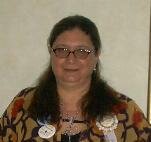
Karin with her husband
Karin Amour, a founding board member of National Fibromyalgia Association discusses the founding of the NFA from its prior organization, the National Fibromyalgia Awareness Campaign, the publication FM AWARE and her own personal battle with FMS. Karin has always been active in the battle for recognition of awareness and understanding of this invisible illness. Meanwhile, she shares her view of advocacy and their experience with legislative work.
Karin also shares the story of her on line dating experience that lead to her marriage to Bill Amour.
AMV: Could you tell us a little about yourself and how you came to find out you have FMS?
Karin: I was injured in 1995, which led to an early diagnosis in March of 1996 by my orthopedic surgeon. My legs had started to hurt badly when my cat would jump up on them to crawl up to my lap. I asked the doctor about it since I had just had ankle surgery and he tested me for the tender points. There it was, (a diagnosis) a word I couldn't pronounce or find any information about. I began to call it the F-word. I had a fairly stressful job at the time and realized that I was starting to lose things, file things incorrectly, and have problems with communications, both verbal and written. Being marketing and public relations professional, this led to problems at work, which eventually led to my taking a disability leave.
AMV: How did you educate yourself about Fibromyalgia?
Karin: I knew I had it in 1996 but didn't know what to do about it. I finally started with a rheumatologist in January of 1997 and began the long road to finding the right cocktail of pharmaceuticals, exercise, relaxation and therapy that would help me. I would hit the Internet every night. Whenever I would find something, I would print it out. Nothing made much sense. All I knew is that it hurt, a lot. I was fortunate to have one of the top doctors in the (Southern California) area for FM as my doctor (and he still is today) and he explained everything he knew to me, but it was never enough. It still isn't enough today. Although we’ve come a long way toward finding solutions, we certainly can't say why, what and how this illness comes to fruition.
AMV: How did you join the NFA? Could you tell us how the National Fibromyalgia Association came from the National Fibromyalgia Awareness Campaign, and how the magazine FM AWARE was started?
Karin: Well, back then (in 1997) the organization was just beginning to form. I had joined a support group at a local medical center and that had helped some but there was this hole in me that needed filling. My doctor picked up on it and suggested I call Lynne Matallana. He said she needed some help putting together an event where some guy was going to ride his bike from Chicago to Los Angeles on Route 66 to raise awareness for fibromyalgia. Since I had the media and marketing background, it was a natural fit. The minute I met Lynne I knew with her red hair and my almost red hair, (I knew) we'd be a pair to be contended with. NFAC (the National Fibromyalgia Awareness Campaign) went on the map starting that melting hot day back in 1997 both here in Southern California and in Tennessee where Karen Lee Richards lives. She had met Lynne on a chat board and the two had decided to form the organization. It was so much fun that day and I knew immediately that I had found something to fill that hole, that emptiness that had haunted me. Getting active and helping others takes my mind off of myself and truly does make a difference.
We're now known as the National Fibromyalgia Association, have a real board of directors, a real office (as opposed to the humble beginnings we had in the loft at Lynne and Richard's house); we have volunteers, a few real employees and still, a lot of people looking for information. I'm amazed at how far we've come. We've put on two very large conferences (FAME Los Angeles and FAME Chicago) as well as numerous regional conferences. We attend the annual meetings of rheumatologists, pain doctors, family practice doctors, and all sorts of other professionals. We've created a website, a full-color glossy magazine, the online newsletters...we try to fill the needs of the patient, the physician and even the caretakers. We manage an incredible load of work with a very small staff but we love it.
AMV: Do you take part in advocacy activities? Could you tell us how the proclamation program began?
Karin: Advocacy work is important with Fibromyalgia because it is still thought of as a "mental" or "weak" persons' disease in some circles. By educating the public, we are enabling those with the illness to become empowered and feel they can talk about it rather than hiding behind a veil of pain. A large part of Lynne's background was working with government officials and she had learned to respect the word "campaign" as something that would make a difference. Hence, we were the Awareness Campaign. We started the Mayor's Proclamation Program so people could get out of their homes and receive a proclamation stating that May 12 was declared as Awareness Day in their cities, counties and states. I'll never forget one year we did a big push for the southern California cities to do proclamations. We even got the Los Angeles County Board of Supervisors to participate. Unfortunately, I had just had ankle surgery (yet again) and was in a wheelchair. The handicap ramp up to the Supervisors platform was broken! So much for the Handicapped Accessible sign outside the chambers! One of the county supervisors and a couple of others helped me HOP up to the platform for our picture with the supervisors. That picture hangs proudly on our Wall of Fame in our offices. We had over 50 volunteers there to go up on that platform and show those people what the face of FM looked like. It made us feel great. The program still goes on each year and attracts people that return every year and those that are new. This year we're going to do a recap of the events in our magazine and on our website to show everyone what just one person can do!
AMV: What are some of the stumbling blocks that you see for the average patient? Do you think there is anything experienced advocates could do to help?
Karin: There are a lot of stumbling blocks out there for people with FM and other invisible illnesses. Even when I had a back surgery, a lady with a grocery cart got a bit pushy with me and hit me in the back with her cart. I was buckled over in pain and she just looked at me like I was crazy. When I was finally able to stand up, I told her she had just hit 26 stitches square on and it was really painful. You know, she couldn’t even say she was sorry. She just indicated to me to move on. So it isn't just those with invisible illnesses who run into trouble. I think one of the toughest is the Handicapped Parking Permit. People see you and stop you and say, "Why are YOU parking there?" Five years ago I couldn't say, "I have fibromyalgia and it hurts just to walk," so I would retort with, "Do you know what it is like to have cancer?" I didn’t say I had cancer but they would back off just the same, usually with a sheepish and embarrassed face. Today, I think we're really close to being able to say, "I have FM and I hurt" and not be laughed at. We managed to get Dateline--NBC to cover it and just recently Newsweek did a great article on Lynne and Dr. Clauw's work. Those little steps are slowly breaking down those big stumbling blocks.
Experienced advocates need to be hired to do lobbying, true advocacy work and public relations. As a non-profit, we're not set up to do that kind of work but I hope to see it in the future. For now, we are focusing on educating as many as we can about FM and how it can affect not only the patient but also the families and friends that surround them. We are also working on a project to make it easier for physicians and other allied health professionals to learn about FM.
AMV: If you could pass a law tomorrow to help FMS and CFIDS sufferers, what would it be?
Karin: It would be tough to pass a law for all FM and CFIDS sufferers because the disease affects different people in different ways. But for sure, we need recognition of the illness in all forms of disability. The insurance companies, disability officials such as the SSA and the VA, state and local disability agencies all need to get on board with a concrete rule about how disabling the illnesses can be. We have made small inroads in this direction such as Ruling 99-2p in the Health and Human Services arena but it doesn't seem to be trickling down the people that make the decisions such as the nurses at the disability insurers, the ALJ's in the SSA system and the doctors who review cases for state and local disability. I still don't understand how a doctor who has never been in practice or treated an FM patient can sit in judgment and say, "You're not disabled." Maybe that would be the best law: Be it proclaimed that if you haven't treated FM, you can't judge a case on FM.
AMV: Do you think that there is legislative work that we should be doing at the state or local level? What type?
Karin: We've attempted some state legislative work in California and found it to be extremely difficult. When they say "politics" are involved, you have no idea how true that statement is. We had a bill all the way through the committee system and into the final signing when at the last minute, some assistant to somebody decided their funding was better placed in another arena. This kind of stuff happens all the time and for those of us with FM, it involves a lot of travel, many meetings and endless rounds of negotiation. Honestly, I think I'd go back to saying that we need the professional lobbyists and advocates to take on our cause and get it through the system. Until we have more media coverage and the CDC starts to work in recognizing the real population figures for FM and CFIDS, we probably won't be able to get much done.
AMV: What services do you think cities or states could offer patients with FMS or CFIDS?
Karin: There are so many services out there that could be turned toward FM and CFIDS patients! We have a wonderful service in the city I live in that provides shuttle service for $0.50 each way to the doctor, shopping, errands, etc. Sure it takes a bit longer but they are handicapped equipped and treat you like a human being. Seniors mostly use it but I sure used it after one of my surgeries and it came in very handy when I couldn't drive. Caretaker services, home aides to help with cooking and cleaning, access to good information and qualified health care, health fairs, the list (of needed services) are endless. Most of the options are out there but not always available for those under 65 or without a "visible" disability. When I lived in Los Angeles, I found it extremely difficult to survive on the disability money I was getting and just taking a taxi to the store because there was no other way. I didn't qualify for "assistance" because I had my own apartment. Even services such as bill paying and home food delivery would be welcome. If I could take all the things they do for seniors and get them for FM and CFIDS people, I'd be happy!
AMV: You have managed to have a personal life despite your illness. You recently wrote an encouraging article about how you met your husband via Internet dating. Did you tell him early in your relationship that you had FMS?
Karin: Absolutely. Honesty about my health and lifestyle was the single most important thing to make the relationship work. The last thing I wanted to have happen was to fall in love and then tell him I was ill and have him leave. That would have broken me in half. So I was pretty upfront with the fact that some days I couldn't get out of bed or go to the store. I got lucky and found a good, kind man who understands that everything in life isn't perfect. There are days when it isn't easy for him to watch me in pain but we get through it.
AMV: Do you have any advice for patients on how to get their families, spouses and partners to be more supportive?
Karin: I would strongly suggest getting a copy of Dr. Mark Pellegrino's book, The Fibromyalgia Supporter. I made my sister and niece read it and they suddenly saw me in a different light. I'd also suggest getting literature that is simple to read, factual and short. If people are bombarded with reams of paper describing every single study that has been done on FM, they'll go nuts. Keep it simple and honest. When you hurt, don't be a martyr. Let your spouse or children know that you're in pain and need some down time. If doing laundry would just hurt too much, tell the family that you can either do it later or they can pitch in and help. I really believe that asking for help isn't a bad thing although sometimes I find it hard to do. Find a support group and attend the meetings and take your family with you. Sometimes if they hear others talking about the same thing you complain about, it somehow becomes real to them. If there isn't one in your area, get onto the Internet and join a chat group. There are many out there with lots of people participating. I also really like our magazine, Fibromyalgia AWARE, but of course I'm biased. Putting a copy of that out on the coffee table isn't like having brochures or medical papers out. It has a friendly cover that appeals to the general public, not just those with FM. You never know, they may want to read it.
All opinions are those of the person interviewed and not those of Our FM-CFS World, Inc.
 |
Interview Conducted By:
Anne-Marie Vidal
Awareness and Advocacy Coordinator