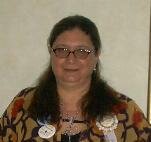
We had the opportunity to talk to Sabrina Dudley Johnson, Founder/CEO of the Fibromyalgia Association Created for Education and Self-Help, (FACES) recently. Sabrina is an impressive advocate who co-hosted FAME 2001 in Chicago last year, with the National Fibromyalgia Association (formerly known as the National Fibromyalgia
Awareness Campaign) led by Lynne Matallana, in California. FACES is a Chicago, Illinois 501 (c) (3) nonprofit organization.
On May 11, Sabrina was a moving speaker at Invisible No More FMS-CFIDS-MCS-MPS event in the metropolitan Washington, DC area.
OFCW: Sabrina would you mind telling us about yourself and how you came to have Fibromyalgia?
Sabrina: I was a police officer with the Chicago police department and sustained three in the line-of-duty injuries.
OFCW: When did these occur?
Sabrina: Between June 1991 and May 1992, I sustained seemingly minor injuries during two separate violent altercations with suspects resisting arrest (that's police jargon for reverse police brutality, but no one ever wants to discuss this issue). I also sustained minor whiplash-like injuries during a rear end vehicle collision while in a marked squad car.
I was originally diagnosed with Bilateral Carpal Tunnel Syndrome and Meniere’s disease; a disorder of the inner ear often accompanied by migraine headaches and severs vertigo. I underwent a Left Carpal Tunnel Release and was actually scheduled for surgery on my ears when the ENT specialist reviewed my medical chart detailing the injuries I had suffered and he said, "Did you know you have Fibromyalgia?"
OFCW: That was a surprise! What was your reaction?
Sabrina: I was angry and realized that an accurate diagnosis, my own diagnosis was withheld from me for 6 months. When I later asked the physician who made the original diagnosis why he had not told me, he replied, "You didn't fit the patient profile." You see, all too often it is assumed that Fibromyalgia patients are Caucasian women who are peri-menopausal.
I also became aware that, at that time, Fibromyalgia was often thought to be psychological. If my condition were psychological in nature, any resulting disability would not be thought of as being the direct result of my duty related injuries. Therefore, I would not be eligible for duty related disability pension benefits. Also, if my condition were psychological in nature, my department would have the right to terminate me on the grounds of unfitness for duty.
Because of this, I was reluctant to admit that I had FM for a while. When I could no longer hide the fact that I was disabled and in need of a plethora of accommodations, it was like "coming out of the closet" within the police department.
OFCW: I know you are a divorced single mother with two children; how did your children react to you having Fibromyalgia?
Sabrina: In certain ways, Fibromyalgia gave my children their mother back. The only way I could keep up with the demands of police work was to sleep every available moment. That meant working different shifts from my husband (who was not a police officer, didn't understand the paramilitary atmosphere of the department and who came from a family that despised 'feeble lazy people"), and not spending enough time with the children. When I left the police department on medical leave in 1994 it gave me the opportunity to spend more time with them.
When I divorced, the judge asked my children whom they wanted to live with and when they said their Mother, the Judge asked them if they knew that I was sick. My daughter who due to delayed hearing had a speech impediment, answered, "Yes, my mother has 'fries-on-her-algae'. She later wrote a poem called "Fries on my algae". She was 8 then.
OFCW: What led to your decision to form FACES?
Sabrina: I had been thinking of forming a group because I could not find any groups that addressed my needs as an African American Woman, Disabled Police Officer, or as a woman struggling to keep her marriage together in the face of unexpected disability. I attended a conference in Seattle, WA. in February 1995. The speakers, Dr. Robert Bennet and Dr. Sharon Clark, inspired me. I met several other people with Fibromyalgia who shared my desire to learn positive coping skills, not just sit around and complain. Before that, I had attended some support group meetings sponsored by a leading foundation and I was not really comfortable. I even went through volunteer training and became a self-help course instructor and speaker for them. However, I either felt out of place because the meetings had a tendency to be overtaken by individuals' problems with no opportunity for problem solving or developing coping skills. Sometimes, when I traveled to a meeting in a suburban, the fact that I was African American, with my best friend who is Latina, and from the city would make other participants uncomfortable or outright hostile.
OFCW: That is very unfortunate. Did you form FACES immediately?
Sabrina: I had the opportunity to speak to someone who explained the process of forming a support group step by step. But I had a strong interest in advocacy.
I began holding support group meetings in my home in 1995 as a result. 1996 and 1998 my friend and I attended the conferences in Portland, Ore.
FACES came about as part of the organizing and awareness activities of the support group I formed. Our initial emphasis was self-help and education. Every meeting a group member was asked to research a topic and present information at the following meeting. This allowed everyone to participate and it taught people how to do research and helped them learn to speak for themselves. That is very important for someone who has Fibromyalgia; effective communication with your doctor is necessary. Eventually as we focused more on self-help and education, the support group went to the back burner.
OFCW: What is the mission of FACES?
Sabrina: FACES concentrates on building public awareness, education and understanding of fibromyalgia and its related disorders. We are committed to self-help and education of people with Fibromyalgia and their families. We believe that this is the key to improving the quality of life of all people affected by Fibromyalgia, either directly through their status as patients, or indirectly through their status as spouses, immediate family members, employers, teachers, friends, or coworkers of a person with Fibromyalgia. Our goals include providing information to the general public and education to people with Fibromyalgia and their families. Hopefully that can increase family and spousal awareness and compassion towards the person with Fibromyalgia.
OFCW: Do you think minorities have a more difficult time with FM?
Sabrina: It is harder for minorities to be included in the research and in some cities; it may be harder for the minority population to be diagnosed. Additionally, there are also some cultural feelings that make the diagnosis hard to accept. African American and Latin women are often told they have to be strong and just keep pushing ahead. Being sick is seen as a type of failure, and/or insult to the family. Often African American and Latin women are the head of households, the family breadwinner - if she is unable to work then the family faces untold hardships (both as a result of limited or no income and racially-related barriers). Many "healthy" African American women and Latinas can remember hearing such phrases, as “you have to work twice as hard to get half as much
It is also harder for minority populations to receive adequate care and help for management of chronic pain. There was an article by a physician from Sloan Kettering Hospital in New York that mentioned this. (Sabrina was referring to "Pain and Prejudice" which was a column in the New York Daily News in February 2002.)
Sabrina: Yes, the article quoted Dr. Payne (chief of palliative care and Pain Management) as noting that doctors evaluate patients pain differently based on their gender, age and race. I would even go so far as to add occupation based upon my experiences as a disabled police officer battling chronic pain. In other words, generalizations and assumptions, and unsubstantiated myths like "older people complain", women are hysterical", "minorities have substance abuse problems", and "police officers on disability pension are simply trying to get over on the system", hinder the quality of pain management and the type of help these patients will receive.
Unfortunately, this kind of thinking does affect the way a patient's pain is treated. For example, I went to the same doctor as two friends who also had Fibromyalgia. One was Hispanic, her pain was treated with Tylenol-3; one was a Caucasian woman, who received a prescription for Oxycontin. I (the African American - disabled police officer) was told to go home, take two aspirin, "and don't call me in the morning”.
But the problem is that much of the public perceives FM as a disease that affects middle-aged women. This excludes the men who have FM and the children who are affected by this disorder.
OFCW: You are based in Chicago, as is the Oprah Winfrey show? Could you tell us about any contact you have had with the producers of the show?
Sabrina: In late 1995 my friend Rosemary Ruiz and I attended a taping of the Oprah Show. The shows theme was women who are afraid to go to the doctor. Rosemary had not been to an OB/GYN for quite some time and we were both going through “doctor withdrawal” due to so many doctors who knew nothing about FM. We actually had the opportunity to speak directly to a producer, who thought FM was fascinating. During the show I was given the opportunity to mention FM to Ms. Winfrey. After the show Ms. Winfrey stood and shook hands of each audience member. Again, I took the opportunity to talk about FM. At this time the producer asked how many other people have FM and could we get them to write to the show about their experiences. That is when the idea for a Media Awareness Campaign project for the support group was born. During the 1996 of the Portland, OR conference, Rosemary and I brain stormed with Mary Ann Saathoff of the Fibromyalgia Organization in Ohio about how to get the word out that we wanted to try to get Oprah Winfrey to do a positive show highlighting Fibromyalgia. We began spreading the word that we wanted all people with Fibromyalgia to write letters and emails to Ms. Winfrey. We personally collected over 650 letters and Rosemary and I hand delivered the letters to the Oprah Show. We were told, "Oh, we did not mean for you to hand deliver these." Although, Oprah herself stated "how interesting." not much has happened - although Fibromyalgia has been mentioned on the show.
OFCW: What direction would you like to see Advocacy take?
Sabrina: There are a couple of things that are important. It would be a step forward to form a national coalition with representatives of FM, CFIDS, and Multiple Chemical Sensitivity groups to work to coordinate Awareness activities and to coordinate plans to have our disorders receive adequate research funding. FACES has been working since 1997 to build a national coalition, we have reached out to many organizations, support groups and individual advocates and activist across the country. Each invitation is initially met with enthusiasm and conditional commitment. These positive imitative responses soon peter out as time goes by often because people were not prepared for the amount of work required to build a national coalition, or because those organizations, groups and/or individuals responding had hidden agendas that did not mesh with a national focus.
Our advocacy groups need to work together. We need legislation to protect our rights as individuals with disabilities and to provide social services developed specifically for emergent/hidden disabilities such as FM and similar invisible chronic illnesses. We need to figure out how to get disability organizations to work with our population’s FMS and its related conditions (and I can't forget disable police officers) and start helping us to accept and live the Independent Living Philosophy and Self-help movement so that we can help ourselves get the most out of our lives.
We have to stop looking at ourselves as people with a defective medical problem who have to be fixed; we need to look at empowering ourselves as people who have special needs at the current time in our lives, know what those needs are, know or are willing to learn how those needs can be met, and are willing to take the steps necessary or direct others to take the steps necessary to fulfill those needs.
We at FACES have been stating since our formal incorporation in 1998, that we need a wellness center, a social service center established solely for people with Fibromyalgia, other chronic pain and fatigue producing conditions. We have listened to a multitude of people with Fibromyalgia giving voices to the unheard faces when they state, "funding research into a cause and cure of FM is a very noble quest, but what can be done to help me now. Will funding research for a cure, help me purchase prescription medication, pay my utilities or obtain groceries NOW.” For far too many times, people with FM have been turned away from social service centers because "they do not look disabled", or because the intake worker "never heard of FM". We at FACES realize that needy, disabled people with Fibromyalgia are not looking for a hand out but are looking for a hand up (to borrow from a cliché). We also know that if in-fighting, jealousy and secrecy remain the norm amongst FM organizations, groups and individual advocates/activist as well as between those of FM and other conditions, OUR Collective NEEDS WILL NEVER BE ADDRESSED OR MET!
A CALL TO ACTION
If you or someone you know is ready to join the movement towards a National
Fibromyalgia Coalitions please send a self addressed stamped ($1.02 in stamps)
to:
FACES
Planning Committee for a National FM Coalition
P. O. Box 497306
Chicago, Illinois 60649
Sabrina Dudley Johnson
Founder/CEO
F. A. C. E. S., INC.
All opinions are those of the person interviewed and not those of Our FM-CFS World, Inc.
 |
For more on Sabrina:
|
Interview Conducted By:
Anne-Marie Vidal
Awareness and Advocacy Coordinator